
Beauty Products That Trigger Eczema: What You Need to Know

TL;DR:
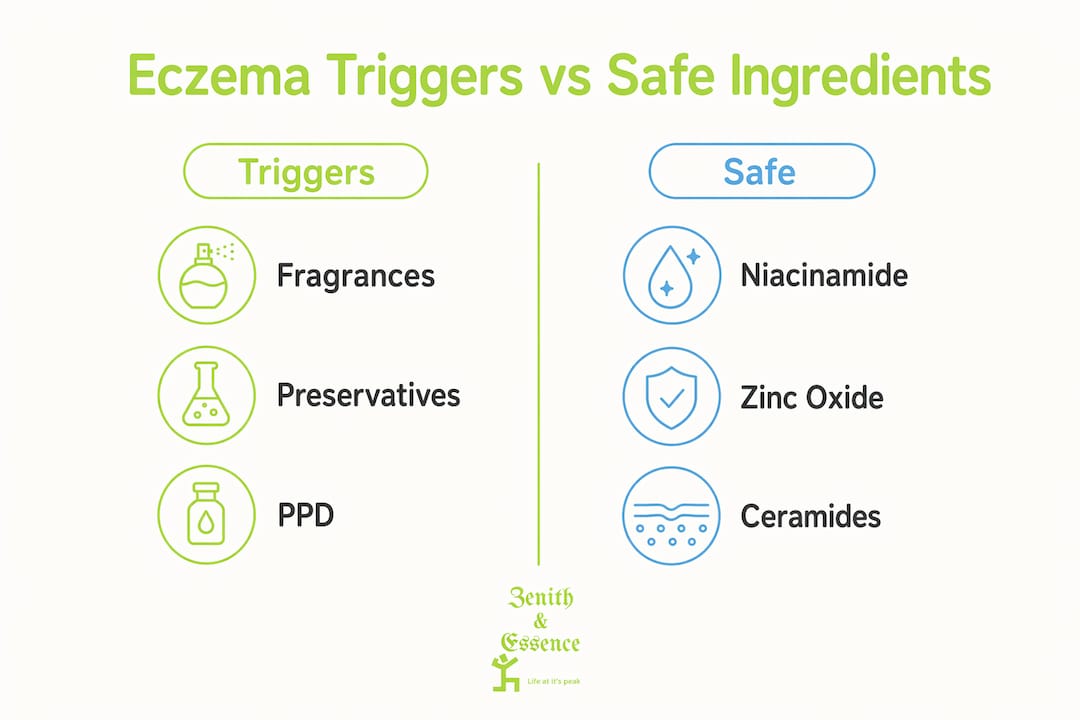
Beauty products can trigger eczema by provoking allergic contact dermatitis from ingredients like fragrances, preservatives, and PPD. Managing flare-ups involves identifying triggers through patch testing, using gentle application techniques, and choosing barrier-supporting ingredients like niacinamide and ceramides. A personalized, eczema-friendly skincare routine may improve skin health and emotional well-being.
Eczema triggered by beauty products is, at its core, allergic contact dermatitis caused by specific cosmetic ingredients that compromise the skin’s barrier and provoke an immune response. The most common culprits are fragrances, preservatives like methylisothiazolinone and formaldehyde, and para-phenylenediamine (PPD) found in hair dyes. A 2024 systematic review confirmed these as the dominant allergens across cosmetic-induced dermatitis cases globally. What makes this particularly tricky is the timing: allergic reactions are delayed, with a rash typically appearing more than 12 hours after contact and peaking around 48 hours post-exposure. You might blame Tuesday’s moisturizer when the real problem was Sunday’s shampoo.
Key triggers to know:
Fragrances (fragrance mix I, Balsam of Peru, cinnamic alcohol)
Preservatives (methylisothiazolinone, formaldehyde, parabens)
PPD in hair dyes and henna products
Sulfates like sodium laureth sulfate
Retinoids and glycolic or salicylic acids
Alcohols (ethanol, isopropanol)
How beauty product ingredients affect your skin barrier
The skin barrier is the outermost layer that keeps moisture in and irritants out. In people with eczema, that barrier is already compromised, which means even low concentrations of an allergen can trigger inflammation that healthy skin would simply shrug off. Dermatologists emphasize that niacinamide strengthens the skin’s natural barrier and reduces redness, making it one of the few cosmetic ingredients with genuine clinical support for eczema-prone skin.
There’s an important distinction between allergic contact dermatitis and irritant contact dermatitis. Allergic reactions involve the immune system becoming sensitized to a specific molecule, so even trace amounts can trigger a full flare after the first sensitization event. Irritant reactions are simpler: a chemical directly damages the skin without any immune involvement. Both can look identical on your face.
Fragrance and preservative ingredients remain the dominant triggers for allergic contact dermatitis related to cosmetic use, with fragrances and preservatives consistently identified as the most common allergens in cosmetic-induced dermatitis across clinical studies.
Makeup and sunscreens deserve special attention. Of 68 analyzed makeup products in one study, 26.5% contained fragrances and 32.4% contained preservatives. Sunscreens, meanwhile, often include chemical UV filters and fragrance that can irritate reactive skin. Mineral-based sunscreens with broad-spectrum protection and fragrance-free formulas are the recommended alternative.
Pro Tip: Apply niacinamide serum or cream before any other cosmetic product. It creates a barrier-reinforcing base layer that can reduce the irritation potential of products applied on top.
How to identify which beauty products trigger your eczema
Patch testing is the gold standard for identifying specific allergens. A dermatologist applies small amounts of standardized allergens to your back under adhesive patches, leaves them for 48 hours, and reads the results. Because eczema reactions are delayed-type hypersensitivity responses, self-diagnosis is genuinely unreliable. You can use a product for weeks before sensitization tips into a visible reaction.
A practical approach to narrowing down triggers at home:
Stop all non-essential products for two weeks and use only a fragrance-free cleanser and moisturizer.
Reintroduce one product every five days, watching for any reaction on the face, neck, or wherever you apply it.
Photograph reactions with dates and product names to build a timeline for your dermatologist.
Check labels for “unscented” vs. “fragrance-free.” Unscented products often contain masking fragrances that can still trigger eczema. Only “fragrance-free” means no fragrance at all.
Test new products on your inner arm for three to five days before applying to your face.
Pro Tip: Bring your actual products to a patch test appointment. Dermatologists can test you against your own cosmetics, which catches allergens not covered by the standard series.
Managing an eczema-friendly beauty routine
Gentle technique matters as much as ingredient choice. Rubbing or excessive friction during cleansing disrupts the skin barrier even when the product itself is safe. Apply cleanser with your fingertips, rinse with lukewarm water, and pat dry. Never rub.
Practical routine adjustments that reduce flare risk:
Use an alcohol-free, fragrance-free cleanser formulated for sensitive skin.
Apply moisturizer while skin is still slightly damp to lock in hydration.
Choose mineral-based, fragrance-free sunscreen with zinc oxide or titanium dioxide.
Remove all makeup before bed using a gentle, water-based remover and a clean cotton cloth. Makeup wipes can irritate reactive skin.
During a flare, pause makeup on affected areas entirely and focus on barrier repair.
Simplify your routine. Fewer products mean fewer potential triggers.
Pro Tip: Hair care products are a frequently overlooked cause of facial and neck eczema. Shampoos and conditioners that run down over the face and neck during rinsing can trigger reactions in those areas. Tilt your head back when rinsing, or switch to a fragrance-free, preservative-minimal formula.
Which ingredients are safe for eczema-prone skin?
The short answer: look for ingredients that repair and hydrate the barrier, and avoid anything that strips or sensitizes it.
Ingredients that support eczema-prone skin:
Shea butter, glycerin, lanolin, and hyaluronic acid are clinically recognized as safe moisturizing ingredients that promote barrier repair and hydration.
Niacinamide (Vitamin B3) actively strengthens the skin barrier and reduces redness.
Ceramides help restore the lipid layer that eczema-prone skin tends to lack.
Ingredients to avoid:
Fragrances in any form, including “natural” essential oils
Preservatives like methylisothiazolinone, formaldehyde, and parabens
Sulfates (sodium laureth sulfate, sodium lauryl sulfate)
Retinoids, glycolic acid, and salicylic acid, which can dry and irritate compromised skin
PPD in hair dyes and henna products
Alcohols like ethanol and isopropanol
When reading labels, position matters. Ingredients listed in the first three spots make up the bulk of the formula. If glycerin or shea butter appears near the top, that’s a meaningful concentration. If fragrance appears anywhere, that’s a reason to pause. Look for products explicitly labeled “fragrance-free” and “formulated for sensitive or eczema-prone skin.” The formaldehyde-free label is also worth seeking out, given how commonly that preservative appears in cosmetics.
How Essencezenith supports eczema-sensitive beauty needs
Essencezenith curates products with barrier-friendly, sustainable ingredients, specifically to address the gap between conventional beauty retail and what sensitive skin actually needs. The 30-day satisfaction guarantee means you can test a product properly without financial risk, which matters when you’re navigating eczema triggers and need time to observe your skin’s response.
Essencezenith’s approach treats ingredient transparency as the baseline, not a premium feature. Every product in the collection is selected with conscious consumers in mind, prioritizing formulas that support skin health rather than simply covering up concerns.
The sustainable beauty collection includes options formulated for sensitive skin, with clear ingredient labeling that makes it easier to cross-reference against your known triggers. For people managing eczema, that kind of transparency is the difference between a routine that works and one that keeps setting you back.

Key Takeaways
Beauty products trigger eczema primarily through fragrances, preservatives, and PPD, and managing flare-ups requires both ingredient awareness and gentle application technique.
Point | Details |
Top cosmetic triggers | Fragrances, methylisothiazolinone, formaldehyde, and PPD cause most cosmetic-induced eczema flares. |
Skin barrier integrity | A compromised barrier lets allergens penetrate more easily; support it with niacinamide, ceramides, and glycerin. |
Patch testing is essential | Reactions peak around 48 hours post-exposure, making professional patch testing the only reliable way to identify allergens. |
Label reading matters | “Fragrance-free” means no fragrance at all; “unscented” may still contain masking fragrances that trigger reactions. |
Gentle technique counts | Rubbing during cleansing disrupts the skin barrier even when the product formula is safe. |
The case for treating your beauty routine as part of eczema care
Most eczema advice focuses on what to stop doing: stop using fragrance, stop scrubbing, stop layering products. That’s useful, but it misses something. Clinical researchers now advocate integrating beauty routines as a therapeutic part of holistic eczema management, because the emotional burden of eczema, including anxiety, low self-esteem, and social withdrawal, is real and measurable. Telling someone to abandon makeup entirely ignores that.
The more useful frame is education over elimination. When you understand which specific ingredients trigger your skin, you can make deliberate choices rather than blanket avoidances. Someone allergic to methylisothiazolinone doesn’t need to avoid all skincare. They need to read labels and find preservative alternatives. That’s a much more livable outcome. Personalized skincare, built around your actual trigger profile, is what one-size-fits-all beauty consistently fails to deliver.
The emotional dimension also deserves acknowledgment. Eczema affects how people feel in their own skin, literally and figuratively. A well-chosen beauty routine, one that respects the barrier rather than attacking it, can restore a sense of control that flare-ups tend to strip away. That’s worth pursuing thoughtfully, not abandoning out of fear.
FAQ
What is eczema triggered by beauty products?
It’s allergic contact dermatitis caused by specific cosmetic ingredients, most commonly fragrances, preservatives like methylisothiazolinone, and PPD in hair dyes, which provoke an immune response and disrupt the skin barrier.
How long after using a product does an eczema reaction appear?
Reactions typically appear more than 12 hours after contact and peak around 48 hours post-exposure, which is why identifying the exact trigger product can be difficult without patch testing.
Is “fragrance-free” really different from “unscented”?
Yes. Fragrance-free means no fragrance ingredients at all. Unscented products often contain masking fragrances that neutralize odor but can still trigger eczema in sensitive skin.
Can sunscreen cause eczema flare-ups?
Yes, particularly chemical sunscreens with fragrances or preservatives. Mineral-based, fragrance-free sunscreens with zinc oxide or titanium dioxide are the recommended option for eczema-prone skin.
Which moisturizing ingredients are safest for eczema?
Shea butter, glycerin, lanolin, hyaluronic acid, and niacinamide are clinically supported options that hydrate and repair the skin barrier without the sensitization risk of fragrances or harsh preservatives.
Recommended
Comments