
How to Read Beauty Product Labels: 2026 Guide

TL;DR:
Reading ingredient lists reveals the true composition of beauty products, as regulations require ingredients to be listed by weight. Active ingredients’ placement indicates their effective concentration, helping consumers determine if a product will deliver results. Understanding label details allows shoppers to avoid misleading claims, potential irritants, and formulate based on proven ingredient concentrations.
Reading beauty product labels is the single most reliable way to know what you are actually applying to your skin. The front of a package is marketing. The back is the truth. Ingredient lists follow strict regulatory rules, including the International Nomenclature of Cosmetic Ingredients (INCI) standard, which governs how every ingredient is named and ordered globally. Knowing how to interpret that list protects you from irritants, helps you recognize effective concentrations, and cuts through misleading claims before you spend a dollar.
How are ingredients ordered on beauty product labels?
The INCI standard requires that ingredients appear in descending order by weight. The first ingredient listed is present in the highest amount. The last ingredient is present in the smallest amount. This single rule tells you more about a formula than any claim printed on the front.
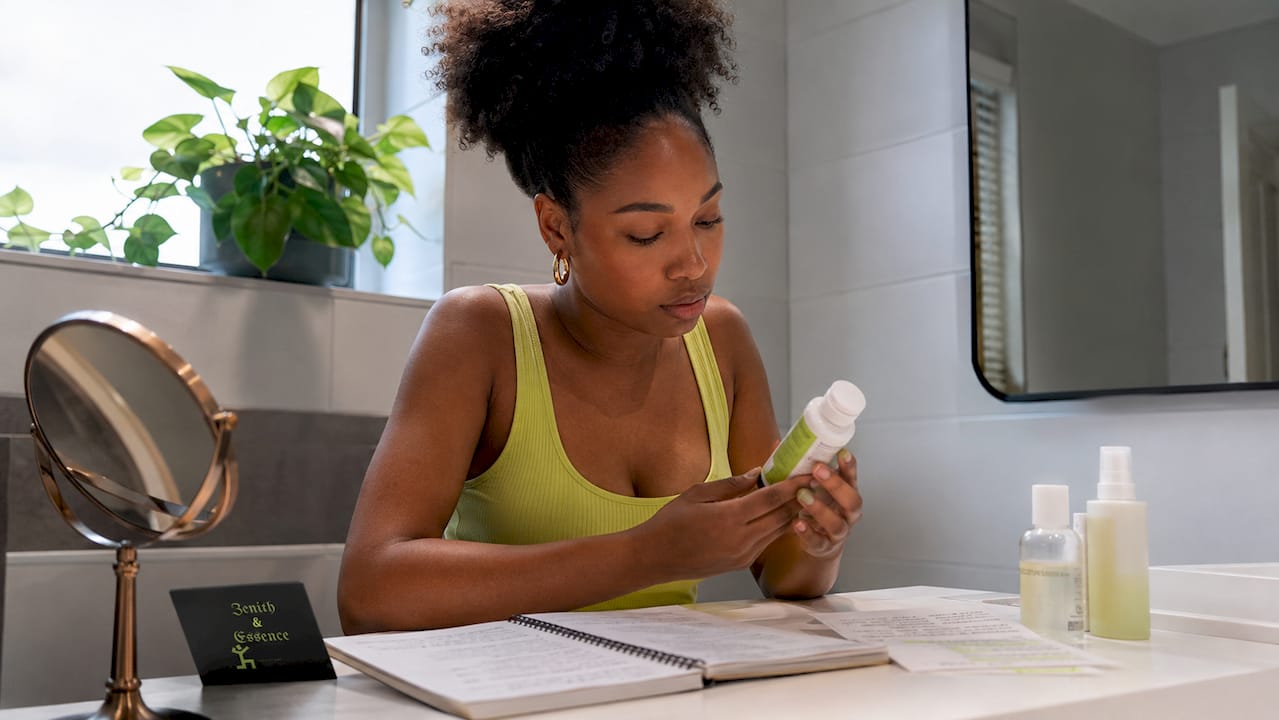
There is one important exception. Ingredients under 1% by weight can be listed in any order after the main ingredients. This means a brand can place a trendy active like bakuchiol or peptides near the middle of the list even when it is present in a trace amount.
The 1% line and how to find it
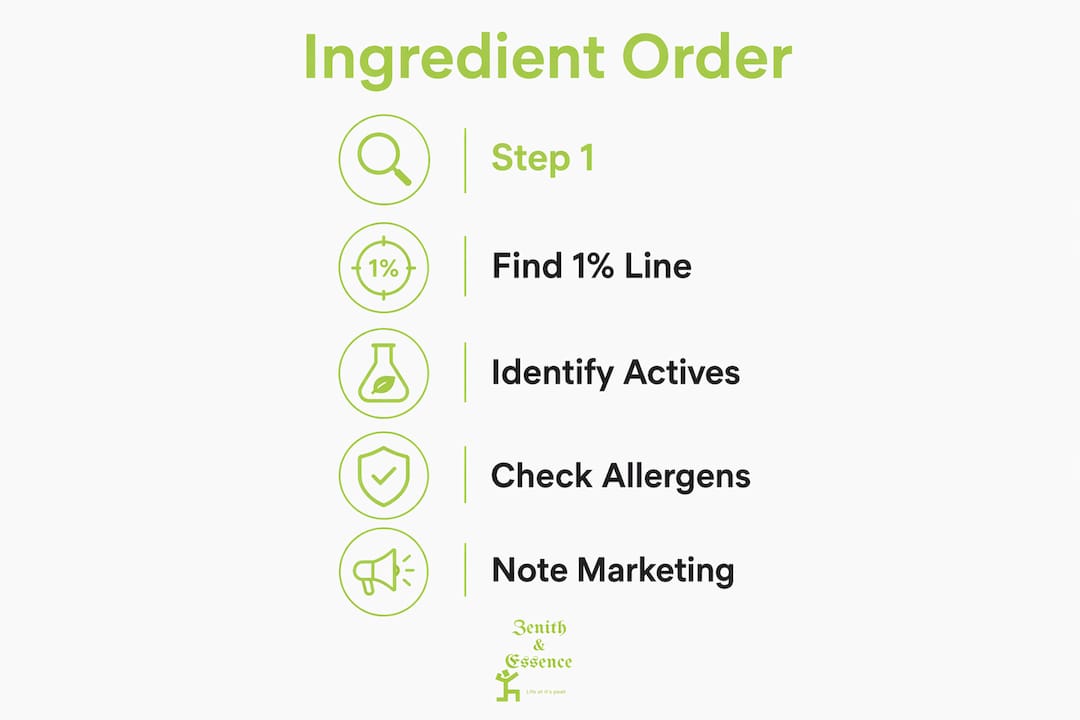
Cosmetic chemists use a practical trick to locate the 1% threshold. Preservatives like phenoxyethanol almost always appear at or below 1% concentration. When you spot phenoxyethanol, ethylhexylglycerin, or sodium benzoate on a list, everything listed after those preservatives is likely at 1% or less. Actives listed below that line are present in amounts too small to produce a clinical effect.
Pro Tip: Screenshot the ingredient list of every product you buy. When a product is reformulated, the list changes. Comparing screenshots side by side takes less than a minute and catches formula changes before they affect your skin.
Listing conventions differ slightly between the US and the EU. In the US, the Food and Drug Administration (FDA) governs cosmetic labeling. In the EU, the European Commission Cosmetics Regulation applies. Both require INCI ordering, but the EU mandates allergen disclosure for 26 specific fragrance compounds by their INCI name. US labels do not require that level of fragrance detail, which means EU-labeled products often give you more specific allergen information.
Label Region | Governing Body | Fragrance Allergen Disclosure |
United States | FDA | Not individually required |
European Union | European Commission | 26 allergens must be named |
What are active ingredients and why does their position matter?
Active ingredients are the compounds in a formula that produce a measurable skin change. Base ingredients, by contrast, create the texture, deliver moisture, and carry actives to the skin. Humectants like glycerin and hyaluronic acid draw water into the skin. Emollients like squalane and shea butter soften the skin barrier. Occlusives like petrolatum and beeswax seal moisture in.
The position of an active on the ingredient list signals whether it is present at a useful concentration. Effective concentration thresholds for key actives are well established: vitamin C requires 10–20%, niacinamide works at 2–10%, and retinol shows results at approximately 0.3%. If niacinamide appears as the 15th ingredient on a 20-ingredient list, it is almost certainly below 2% and unlikely to deliver visible results.
How to assess actives in four steps
Find the active you care about on the ingredient list.
Count its position relative to the total number of ingredients.
Check whether it falls before or after the 1% line (look for phenoxyethanol as your marker).
Cross-reference its position against the known effective ranges for that ingredient.
Pro Tip: Anhydrous products, meaning formulas with no water, can carry actives at higher concentrations than water-based emulsions. A vitamin C powder or oil serum may deliver a more potent dose than a water-based serum with vitamin C listed fifth.
One more distinction worth knowing: the first five ingredients typically make up 60–80% of a product’s total weight. That range tells you the core formula. If the first five ingredients are water, glycerin, and three thickeners, the product is primarily a moisturizing base. Any actives listed after position five are present in smaller amounts.
How do you decode marketing claims on cosmetic labels?
Marketing claims on beauty packaging are largely unregulated. Terms like “natural,” “dermatologist-tested,” “clinically tested,” and “hypoallergenic” carry no standardized legal definition in the US. A brand can print “dermatologist-tested” on a product after a single dermatologist reviewed it, with no requirement to share the results. The INCI ingredient list is the only part of the label that offers objective transparency.
“Fragrance-free” and “unscented” are not the same thing. Fragrance-free means the product contains no added scent compounds. Unscented products often contain masking fragrances designed to neutralize the smell of other ingredients. Those masking fragrances can still trigger reactions in people with sensitive skin or fragrance allergies.
The fragrance-free versus unscented distinction matters most for people with reactive skin. If you have a known fragrance sensitivity, “unscented” on the label does not protect you. Only “fragrance-free” does.
Third-party certification symbols add a layer of verified accountability that marketing claims cannot. Certifications from organizations like COSMOS, USDA Organic, and EWG Verified require brands to meet documented ingredient standards. Understanding what those certification symbols mean before you buy is worth the two minutes it takes to look them up.
Watch for vague ingredient descriptions like “botanical complex,” “proprietary blend,” or “encapsulated actives.” These terms are not regulated and tell you nothing about what is actually in the formula or at what concentration. A brand using these terms may be protecting a trade secret, or it may be obscuring a low-dose ingredient behind appealing language.
What practical steps help you read a label quickly?
Skilled label readers use a five-step method that takes about 30 seconds. Consumers can evaluate a product’s composition in as little as 30 seconds by following a structured process. That speed comes from knowing exactly what to look for and where.
Ignore the front of the package entirely. Marketing copy tells you what the brand wants you to believe. The ingredient list tells you what is in the bottle.
Read the first five ingredients. These form the core formula. Identify whether the base is water, oil, or silicone, and note any actives in this top tier.
Scan for your personal allergens. If you know you react to fragrance, methylisothiazolinone, or a specific botanical, search for it before reading anything else.
Locate the 1% line. Find phenoxyethanol or another common preservative to mark where high-concentration ingredients end.
Check the last 20% of the list. Fragrance, colorants, and potential irritants cluster here. A product with fragrance listed in the top ten ingredients contains a significant amount.
Pro Tip: Keep a notes app on your phone with your personal trigger ingredients listed. When shopping in-store, use your phone’s camera to zoom in on small-print labels. When shopping online, zoom into product images or check the brand’s website for the full ingredient list before purchasing.
Reformulations are a real risk. Brands change formulas without announcing it, and the packaging may look identical. Checking the ingredient list on every new purchase, even for products you have used before, catches those changes. Essencezenith addresses this directly by providing full ingredient transparency on every product page, so you can verify the current formula before buying.
What are the red flags and allergens to watch for?
Certain ingredients appear repeatedly in adverse reaction reports. Knowing them by name lets you scan a label in seconds.
Fragrance / parfum: The single largest allergen category in cosmetics. A product listing “fragrance” or “parfum” may contain dozens of undisclosed scent compounds.
Methylchloroisothiazolinone (MCI) and methylisothiazolinone (MI): Preservatives linked to contact dermatitis. The EU restricts MI in leave-on products. US labels do not require the same restriction.
Sodium lauryl sulfate (SLS) and sodium laureth sulfate (SLES): Surfactants that strip the skin barrier. They are effective cleansers but harsh for dry or sensitive skin types.
Denatured alcohol (alcohol denat.): Drying at high concentrations. When listed in the first five ingredients, it can compromise the skin barrier over time.
Formaldehyde releasers: Ingredients like DMDM hydantoin, imidazolidinyl urea, and quaternium-15 slowly release formaldehyde as a preservative. They are legal but cause reactions in some people.
Synthetic dyes (FD&C or D&C colors): Added for appearance only. They offer no skin benefit and can irritate sensitive skin.
Learning 10–15 common allergens lets you avoid 90% of potential skin reactions. That is a high return for a small investment in label literacy. Botanical ingredients also carry allergen risk. INCI Latin names like Lavandula angustifolia (lavender) or Citrus aurantium (bitter orange) signal plant-derived compounds that cause reactions in some people, even when marketed as natural and gentle.
Key Takeaways
Reading beauty product labels accurately requires knowing INCI ordering rules, recognizing the 1% concentration line, and ignoring unregulated marketing claims in favor of the ingredient list.
Point | Details |
INCI ordering reveals formula weight | Ingredients listed first are present in the highest amounts, forming the core formula. |
The 1% line marks low-dose actives | Preservatives like phenoxyethanol signal where high-concentration ingredients end. |
First five ingredients are the formula | The top five ingredients typically make up 60–80% of the product’s total weight. |
Marketing claims are unregulated | Terms like “natural” and “dermatologist-tested” carry no legal standard in the US. |
Fragrance-free differs from unscented | Only fragrance-free guarantees no added scent compounds; unscented may still contain masking fragrances. |
Why label literacy changed how I shop for skincare
I spent years buying products based on packaging and price. A serum with a clean white label and the word “clinical” on the front felt trustworthy. Then I learned to read the actual ingredient list, and the experience was genuinely humbling. Products I had trusted for months had the actives I was paying for listed after the preservatives, well below any effective concentration.
The shift that helped me most was not memorizing a long list of ingredients. It was learning three anchor points: the first five ingredients, the 1% line, and the position of the one active I cared about most. With those three reference points, I could assess a new product in under a minute. That skill has saved me from buying ineffective products far more reliably than any review or influencer recommendation.
The uncomfortable truth about beauty marketing is that it works precisely because most people do not read ingredient lists. A product can contain 0.01% of a trending active, list it on the label, and feature it prominently on the front of the package. Nothing about that is illegal. The only defense is knowing how to spot misleading products before you buy them.
My advice: start with the ingredients you already know you react to. Build your personal allergen list first. Then add one or two actives you want to prioritize. That focused approach builds real label literacy faster than trying to learn every ingredient at once.
— Norman
Essencezenith makes transparent beauty shopping straightforward
Knowing how to read a label is only useful when the label gives you the full picture. Essencezenith curates products specifically for ingredient quality and formula transparency, so the information you need is always available before you buy.
Every product in the sustainable beauty collection includes a complete ingredient list, sourcing details, and customer feedback on real-world efficacy. The 30-day satisfaction guarantee means you can try a product with confidence. If the formula does not work for your skin, you return it, no questions asked. For shoppers who have done the work to understand labels, Essencezenith is built to match that standard.
FAQ
What does INCI stand for in beauty products?
INCI stands for International Nomenclature of Cosmetic Ingredients. It is the global standard that governs how ingredient names appear on cosmetic labels, making it possible to identify the same ingredient across products from different countries.
How do I find the 1% line on an ingredient list?
Look for common preservatives like phenoxyethanol or ethylhexylglycerin. These are almost always used at or below 1% concentration, so every ingredient listed after them is also present at 1% or less.
Is “fragrance-free” the same as “unscented”?
No. Fragrance-free means no scent compounds were added. Unscented products often contain masking fragrances to neutralize odor, which can still cause reactions in people with fragrance sensitivities.
Are marketing claims like “natural” or “dermatologist-tested” regulated?
These claims are largely unregulated in the US and carry no standardized legal definition. The INCI ingredient list is the only part of the label that provides objective, regulated information about what is in the product.
How many allergens should I learn to protect my skin?
Learning 10–15 common allergens and irritants is enough to avoid 90% of potential skin reactions, making it a practical and achievable starting point for anyone building label literacy.
Recommended
Comments