
Consumer Protection Laws in Beauty: Your 2026 Guide
- Norman Church
- Jun 14
- 8 min read

TL;DR:
Consumer protection laws in the beauty industry aim to ensure safe products, honest marketing, and proper recourse for consumers. The U.S. relies on a post-market model through MoCRA, which enhances FDA authority for recalls and adverse event reporting, while the EU conducts pre-market safety assessments with mandatory product files. Consumers should verify ingredient transparency, scrutinize marketing claims, and document issues to effectively exercise their rights and identify authentic, safe beauty products.
Consumer protection laws in the beauty industry are the legal framework that guarantees your right to safe products, honest marketing, and a clear path to recourse when something goes wrong. The role of consumer protection laws in beauty has expanded significantly since 2022, when the U.S. passed the Modernization of Cosmetics Regulation Act (MoCRA), the most significant overhaul of federal cosmetics law since 1938. At the same time, the EU’s Regulation (EC) No 1223/2009 sets a global benchmark for pre-market safety and transparency. Understanding these laws is not optional knowledge for beauty consumers. It is the foundation for every smart purchase you make.
What are the main consumer protection regulations in beauty?
The two most influential regulatory frameworks governing beauty products today are MoCRA in the United States and EU Regulation 1223/2009 in Europe. They share the same goal but take very different approaches to achieving it.
MoCRA: the u.s. post-market model
MoCRA expands FDA authority over cosmetics in ways that were simply not possible before 2022. Brands must now register their facilities, list their products with the FDA, and report serious adverse events within 15 business days. The FDA also gained mandatory recall authority for the first time. This is a post-market model, meaning products reach shelves before the FDA formally approves them, but companies are legally accountable for safety data and incident reporting after launch.
That distinction matters for you as a consumer. Under MoCRA, a “responsible person” (typically the brand or importer) carries the legal duty to substantiate safety and respond to harm reports. If a product causes a serious reaction, the brand cannot simply stay silent. The FDA can now compel a recall, which was not possible under the old 1938 framework.
EU regulation 1223/2009: pre-market transparency
The EU takes a stricter pre-market approach. EU Regulation 1223/2009 requires every cosmetic sold in Europe to be safe under normal use, with a Product Information File (PIF) compiled before the product hits the market. The PIF must be maintained for 10 years and includes safety assessments, manufacturing data, and substantiation for every marketing claim.
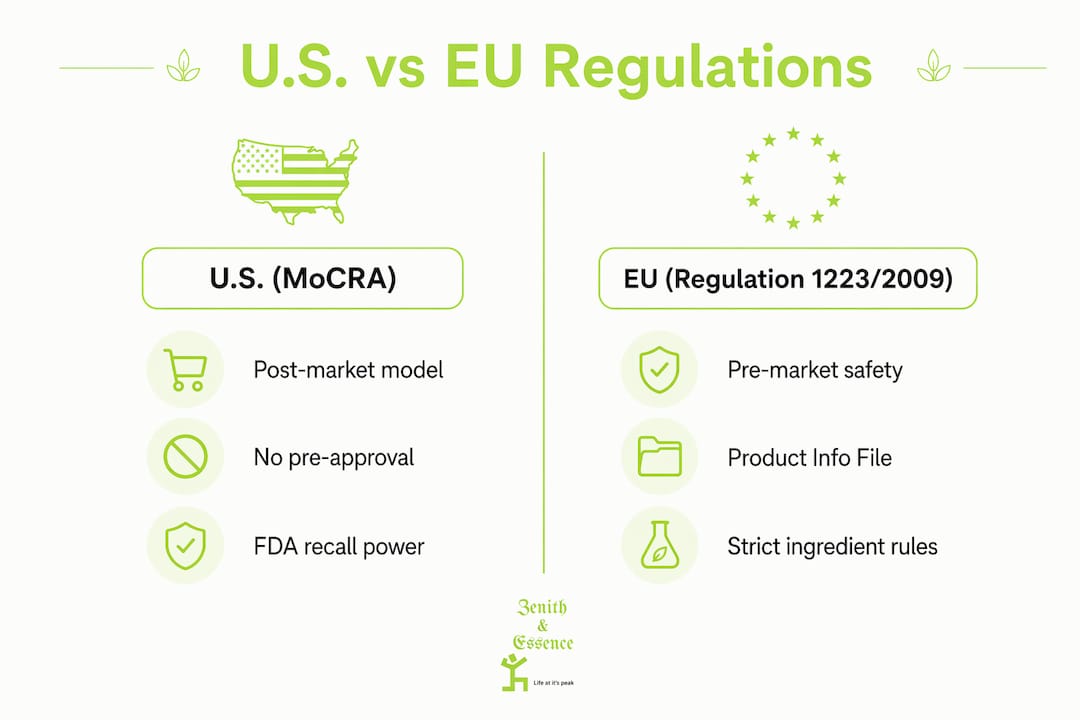
The table below shows how these two frameworks compare on the points that affect you most directly.
Feature | U.S. (MoCRA) | EU (Regulation 1223/2009) |
Pre-market approval | Not required | Safety assessment required before sale |
Product Information File | Not mandated | Mandatory, kept 10 years |
Adverse event reporting | Within 15 business days | Required under responsible person |
Recall authority | FDA can mandate recalls | Competent authorities can order recalls |
Claim substantiation | FTC enforces post-market | Required before any claim is made |
The practical takeaway: EU consumers benefit from pre-market safety checks, while U.S. consumers rely more heavily on post-market accountability and their own vigilance.
How do beauty laws tackle misleading marketing claims?
Marketing enforcement is where consumer protection laws have the most direct impact on what you read on a label. The Federal Trade Commission (FTC) requires substantiation for every health, safety, and environmental claim a cosmetic brand makes. Even scientifically supported claims carry legal risk if the overall advertising misleads consumers. Wording and evidence are both critical.
Since 2020, lawsuits against cosmetic brands have surged over terms like “clean,” “toxic-free,” and “safe.” The legal risk grew because these words have no standardized federal definitions. A brand calling its moisturizer “clean” without a clear, substantiated definition of that term is exposed to class action litigation under FTC rules and state consumer protection statutes.
State laws add another layer of complexity. California has banned many harmful chemicals including PFAS, mercury, phthalates, and parabens, stepping in where federal regulation has historically been limited. When a brand’s product contains a state-banned ingredient, any “safe” or “clean” marketing claim becomes legally indefensible. State toxic-free laws and ingredient bans now interact directly with marketing enforcement, making ingredient transparency and claim wording interconnected in ways that benefit consumers.
Key red flags to watch for on beauty product labels:
Undefined “clean” or “natural” claims with no ingredient list to back them up
“Dermatologist tested” without specifying what was tested or what the results showed
“Safe for all skin types” without any clinical or consumer study data
“Free from [ingredient]” claims that omit other harmful substances in the formula
Vague environmental claims like “eco-friendly” without certification or third-party verification
Pro Tip: Search the FTC’s website for enforcement actions against beauty brands. The cases are public, and they reveal exactly which claim types regulators consider deceptive. It is faster than reading the full regulation.
What rights do you have as a beauty consumer?
Your rights as a beauty consumer fall into three categories: the right to safe products, the right to accurate information, and the right to recourse when something goes wrong.
The right to safe products is enforced differently depending on where you shop. In the U.S., MoCRA now requires brands to maintain safety substantiation and report serious adverse events to the FDA. In the EU, consumer protection laws guarantee rights to safe products, truthful information, and redress, though enforcement in beauty services can be complex and inconsistent. The right to accurate information is enforced through labeling requirements, FTC oversight, and EU claim substantiation rules.
Recourse is where many consumers hit a wall. Here is how to assert your rights effectively:
Document everything. Photograph the product, the label, the receipt, and any adverse reaction. This documentation is your evidence if you file a complaint.
Report adverse events. In the U.S., you can submit a MedWatch report directly to the FDA. Under MoCRA, brands are required to report serious adverse events, but your report creates an independent record.
Contact your state attorney general. State consumer protection offices often move faster than federal agencies on individual complaints, especially for deceptive marketing.
Check for recalls. The FDA publishes active cosmetic recalls on its website. If a product you own is recalled, you are entitled to a refund or replacement.
Use small claims court. For purchases under your state’s small claims limit, you can sue a brand directly without a lawyer if a product caused documented harm.
Pro Tip: Keep your beauty product receipts for at least 90 days. Most consumer protection claims require proof of purchase, and digital receipts from email are accepted in virtually every U.S. jurisdiction.
Beauty services add another layer of complexity. Liability in beauty services varies significantly depending on whether the products used are registered or counterfeit. If a salon uses an unregistered product that causes a reaction, proving liability is harder because the product falls outside the normal regulatory chain. Always ask your service provider which products they use and whether those products are FDA-registered or EU-compliant.
How can you identify safe, authentic beauty products?
Identifying authentic, safe beauty products requires you to look beyond the marketing and focus on verifiable signals. Lack of transparency is a primary consumer harm in beauty. Laws enforcing disclosure exist precisely because consumers should not need advanced chemistry expertise to understand what they are putting on their skin.

Start with the ingredient list. Every product sold legally in the U.S. and EU must list ingredients in descending order of concentration using INCI (International Nomenclature of Cosmetic Ingredients) names. If a product does not have a full ingredient list, that is a compliance failure, not a minor omission. You can cross-reference ingredients against the FDA-cleared beauty devices and cosmetic databases to verify safety status.
Learning to read skincare ingredient labels is one of the highest-return skills you can develop as a beauty consumer. It takes about an hour to learn the basics and saves you from years of buying products that underdeliver or cause harm.
For online purchases, use these verification signals:
Third-party certifications such as EWG Verified, COSMOS Organic, or NSF/ANSI 305 for personal care
Batch code verification using tools like CheckFresh or CheckCosmetic to confirm the product is genuine and within its shelf life
Seller verification on platforms like Amazon, where counterfeit beauty products are a documented problem
Brand transparency pages that publish full formulas, sourcing information, and safety testing results
The Essencezenith guide on authentic beauty products covers the specific signals that separate genuine products from counterfeits in 2026. It is worth reading before your next purchase.
Key takeaways
Consumer protection laws in beauty are most effective when you understand both the regulatory framework and your own rights as a buyer.
Point | Details |
MoCRA changed U.S. law | FDA now has mandatory recall authority and brands must report adverse events within 15 business days. |
EU sets a pre-market standard | EU Regulation 1223/2009 requires safety assessment and a Product Information File before any product reaches shelves. |
Marketing claims carry legal risk | Terms like “clean” and “toxic-free” expose brands to FTC enforcement and class action lawsuits without clear substantiation. |
Recourse requires documentation | Filing FDA MedWatch reports, contacting state attorneys general, and keeping receipts are your strongest tools for redress. |
Ingredient transparency is your defense | A full INCI ingredient list and third-party certifications are the most reliable signals of a safe, authentic product. |
The gap between law and reality in beauty protection
I have spent years reading regulatory filings, FTC enforcement actions, and product liability cases in the beauty space. The honest observation is this: the laws are better than most consumers realize, but enforcement is thinner than the laws suggest.
MoCRA is a genuine improvement. Before 2022, the FDA had almost no authority to compel a cosmetic recall. That changed. But post-market accountability only works if adverse events get reported, and many consumers never connect a skin reaction to a specific product or file any report at all. The law is only as strong as the reporting pipeline feeding it.
The EU model is more protective on paper, but the Product Information File system depends on the responsible person maintaining accurate records. Regulators do not audit every product. They audit when something goes wrong or when a complaint triggers a review.
What I find most encouraging in 2026 is the state-level movement in the U.S. California’s ingredient bans are forcing brands to reformulate nationally, not just for California consumers. That is the real impact of beauty laws: when one major market raises the bar, the whole industry tends to follow. The practical advice I give anyone who asks is simple. Read the ingredient list first. Check for third-party certification. Know your state’s specific ingredient bans. And use the complaint mechanisms that exist, because regulators track complaint volume when deciding where to focus enforcement resources.
— Norman
Shop beauty products built around transparency

Essencezenith was built around the exact principles that consumer protection laws are trying to enforce: full ingredient disclosure, safety-first formulation, and a guarantee that removes the risk from trying something new. Every product in the Essencezenith catalog lists its full ingredient profile, so you can verify what you are buying before it arrives at your door. The natural vegetable deodorant is a strong example of that commitment, formulated without PFAS, parabens, or synthetic fragrances, and backed by a 30-day satisfaction guarantee. If you want beauty products that align with what consumer protection laws are pushing the industry toward, Essencezenith is a direct answer to that standard. You can also review the full types of beauty guarantees that protect your purchase.
FAQ
What is MoCRA and how does it protect beauty consumers?
MoCRA is the Modernization of Cosmetics Regulation Act of 2022, the most significant expansion of FDA cosmetics authority since 1938. It requires brands to register facilities, report serious adverse events within 15 business days, and gives the FDA mandatory recall authority.
Are beauty products approved by the FDA before they are sold?
No. The U.S. uses a post-market model under MoCRA, meaning cosmetics do not require FDA pre-approval before sale. Brands must substantiate safety and report adverse events, but the FDA reviews compliance after products are already on the market.
What does the EU require that the u.s. does not?
The EU requires a Product Information File and a formal safety assessment before any cosmetic product can be sold. This pre-market requirement is stricter than the U.S. system, which relies on post-market reporting and enforcement.
Can you sue a beauty brand for a false “clean” claim?
Yes. Since 2020, class action lawsuits against beauty brands for unsubstantiated “clean,” “toxic-free,” and “safe” claims have increased significantly. The FTC requires substantiation for all such claims, and state consumer protection laws provide additional legal grounds for litigation.
How do you report an unsafe beauty product in the u.s.?
Submit a report through the FDA’s MedWatch program online. Under MoCRA, brands are also required to report serious adverse events independently, but your consumer report creates a separate record that contributes to regulatory enforcement tracking.
Recommended
Comments