
Biotechnology in Beauty: What Your Skin Gains
- Norman Church
- Jun 16
- 7 min read

TL;DR:
Biotechnology in beauty involves using biological processes to create pure, safe, and high-performing cosmetic ingredients. It offers advantages like higher purity, reduced contaminants, and enhanced sustainability through controlled production methods. Growing adoption by major brands and decreasing costs suggest biotech’s pivotal role in the future of clean, effective skincare.
Biotechnology in beauty is defined as the use of living organisms, biological processes, and molecular engineering to create cosmetic ingredients with greater purity, safety, and performance than traditional plant or animal extraction allows. Techniques like fermentation, cell culture, and synthetic biology now produce actives such as vegan collagen, lab-grown squalane, and bioengineered peptides that outperform their conventional counterparts. The global bioeconomy sector supporting these innovations reached a $165.7 billion valuation in 2024, with projections to hit $300 billion by 2030. That number signals a fundamental shift in how the beauty industry sources, designs, and validates its ingredients.
What is biotechnology in beauty and why does it matter?
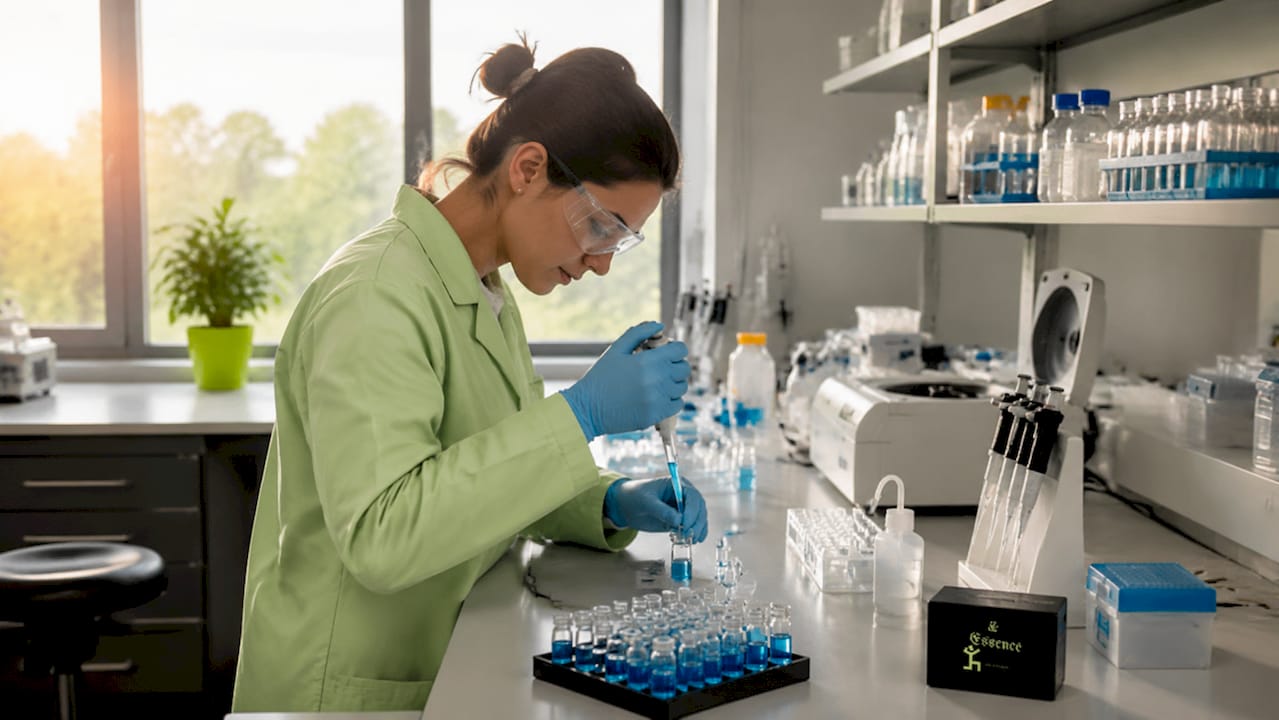
Cosmetic biotechnology is the science of using controlled biological systems to manufacture beauty ingredients at the molecular level. Instead of harvesting a plant root or rendering animal fat, scientists direct microbes, yeast, or cultured cells to produce a specific molecule with a defined structure and function. The result is an ingredient built for a purpose, not extracted by chance.
The practical difference shows up in purity. Biotech actives reach 95–99% purity, compared to the 20–60% purity typical of traditional natural extracts. That gap matters because lower purity means more contaminants, more variability between batches, and a higher risk of skin reactions. Biotech removes that uncertainty by design.
This is not a niche laboratory experiment. Brands from Olay to L’Oréal now formulate with fermented hyaluronic acid, recombinant collagen, and biosynthetic squalane. The shift is happening across every price point, and understanding it helps you read an ingredient label with real confidence.
How biotech ingredients outperform traditional extracts
The clearest advantage of biotechnology in skincare is the removal of unwanted compounds. Biotech-derived ingredients reduce contaminants like allergens, pesticides, and heavy metals commonly present in crude plant extracts. For anyone with sensitive or reactive skin, that reduction is not cosmetic. It is clinical.
Metric | Biotech Ingredients | Traditional Extracts |
Purity level | 95–99% | 20–60% |
Allergen risk | Very low | Moderate to high |
Batch consistency | Controlled and reproducible | Variable by season and source |
Contaminant exposure | Minimal | Pesticides, heavy metals possible |
Sensitive skin tolerability | High | Unpredictable |
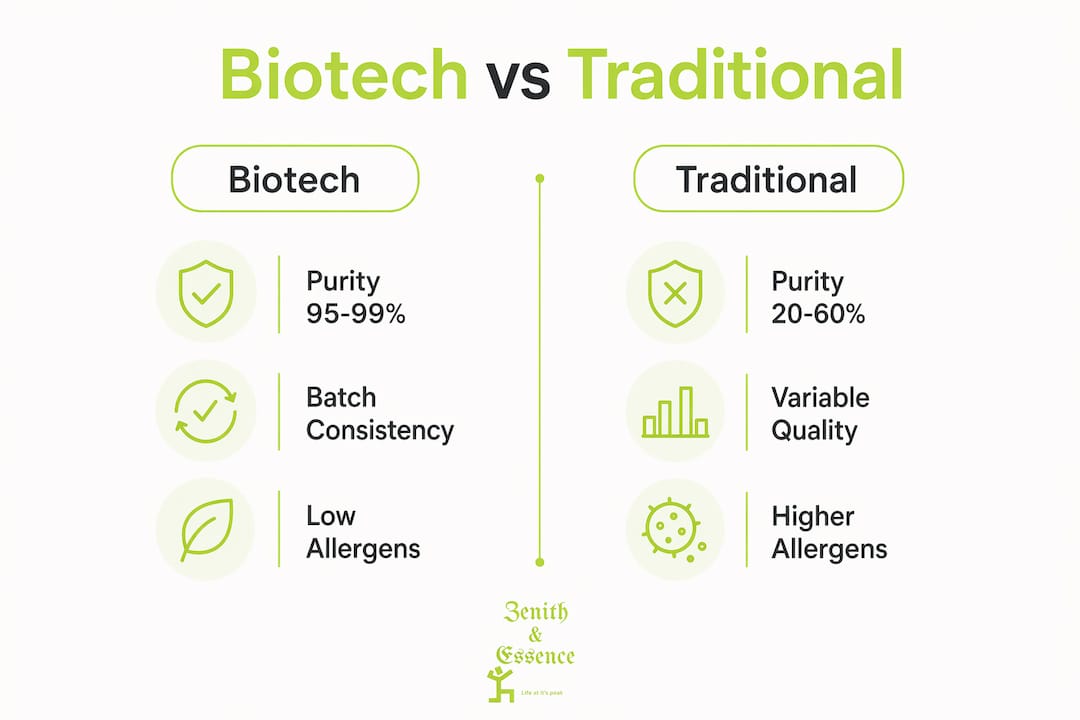
Batch consistency is another underappreciated advantage. A plant harvest varies by season, soil quality, and geography. A bioreactor does not. Formulators using recombinant collagen or fermented hyaluronic acid get the same molecule every time, which means the product you buy in January performs identically to the one you buy in August.
High-purity biotech actives also allow formulators to use lower doses while maintaining or improving efficacy. Less ingredient, same result, and a gentler formula. That is a meaningful benefit for daily-use products like serums and moisturizers.
Pro Tip: When reading a product label, look for terms like “fermented,” “recombinant,” or “biosynthetic” before an ingredient name. These signal biotech origin and typically indicate higher purity than a generic plant extract.
What types of biotech ingredients are in your products?
Biotechnology applications in beauty fall into three main categories, each producing a distinct class of ingredient.
Fermentation-based actives. Yeast and bacteria ferment sugars or plant materials to produce squalane, niacinamide, hyaluronic acid, and certain peptides. Sugarcane-fermented squalane, for example, replaces shark liver oil with a vegan, cruelty-free alternative that delivers identical moisturizing performance.
Cell culture ingredients. Scientists grow human or plant cells in controlled environments to harvest growth factors, collagen, and antioxidants. Lab-grown collagen produced through recombinant DNA technology matches the structure of human skin collagen without involving animals.
Synthetic biology actives. Researchers reprogram microorganisms at the genetic level to produce entirely new molecules. This approach enables the design of novel ingredients not found anywhere in nature, targeted to specific skin pathways like barrier repair or pigmentation control.
Bioengineered peptides. Short chains of amino acids are designed computationally and produced through fermentation. Peptides like Matrixyl and Argireline, both widely used in anti-aging serums, are biotech products that signal skin cells to produce more collagen.
Biosynthetic vitamins. Niacinamide (vitamin B3) and panthenol (vitamin B5) are now produced almost entirely through fermentation, delivering pharmaceutical-grade purity in everyday moisturizers and toners.
The current R&D logic has reversed from traditional discovery. Scientists now design molecules targeted to specific skin pathways first, then build the biological system to produce them. That shift from chance discovery to design-driven creation is what separates modern biotech beauty from everything that came before.
Pro Tip: If you use a serum with peptides, growth factors, or fermented hyaluronic acid, you are already using biotech skincare. The category is broader than most people realize.
Are biotech beauty products better for the environment?
Sustainability is one of the strongest arguments for biotechnology in cosmetics, and the data supports it. Biotechnology enables circular supply chains by converting greenhouse gases into cosmetic-grade ingredients and protecting biodiversity through plant cell culture. One documented example is methane-to-protein fermentation, which captures a potent greenhouse gas and converts it into a usable cosmetic active.
Environmental Factor | Biotech Sourcing | Traditional Sourcing |
Land use | Minimal, lab-based | Large agricultural footprint |
Biodiversity impact | Protects wild species | Overharvesting risk |
Carbon footprint | Lower, circular models possible | Higher, transport and farming intensive |
Animal welfare | Cruelty-free by design | Often involves animal derivatives |
Antioxidant yield | Up to 18x higher from cultured cells | Variable, weather-dependent |
Traditional sourcing of ingredients like rosehip oil, argan oil, and shark squalane puts pressure on ecosystems and wild populations. Biotech removes that pressure entirely. A bioreactor producing squalane from sugarcane fermentation uses a fraction of the land and water that conventional sourcing requires.
The conscious science framework emerging in the industry asks brands to compete on efficacy, traceability, and sustainability rather than vague “natural” claims. Controlled biomanufacturing makes traceability straightforward. Every batch has a documented origin, a verified molecular structure, and a measurable performance profile. That level of transparency is nearly impossible to achieve with wild-harvested botanicals.
For a deeper look at what sustainability actually means in a beauty context, the guide on sustainable beauty practices at Essencezenith breaks down the terminology clearly.
Biotech beauty myths and what is actually coming next
The most persistent myth about biotech beauty products is that “synthetic” means inferior or unsafe. Biotech is not artificial in the way that word implies. It is a high-precision extension of natural biology. Fermentation is the same process that produces yogurt and wine. Cell culture mirrors how your own body regenerates tissue. The difference is control, not artificiality.
Here are the most common misconceptions worth correcting:
“Natural extracts are purer.” Traditional plant extracts contain dozens of uncharacterized compounds. Biotech actives are single, defined molecules at 95–99% purity.
“Biotech ingredients are untested.” Recombinant collagen and fermented hyaluronic acid have decades of clinical use in medical and pharmaceutical applications before entering cosmetics.
“Lab-grown means less effective.” Biosynthetic squalane and lab-grown collagen match or exceed the performance of their animal-derived equivalents in peer-reviewed studies.
The trends shaping the next five years are significant. AI-driven molecular design now allows researchers to screen millions of potential molecules computationally before synthesizing a single gram. Traditional discovery explored only 0.001% of potential molecules. Biotechnology unlocks access to the remaining 99.999%. Personalized biotech skincare, where formulations are tailored to your genetic skin profile, is already in early commercial development.
The main challenge is scale. Translating lab-scale innovations into industrial production with consistent quality and cost control remains a real bottleneck. That is why some biotech actives still carry a premium price. As manufacturing technology matures, those costs will fall. Knowing how to spot authentic biotech products now puts you ahead of that curve.
Key takeaways
Biotechnology in beauty produces ingredients that are measurably purer, safer, and more sustainable than traditional plant or animal extraction can deliver.
Point | Details |
Purity advantage | Biotech actives reach 95–99% purity versus 20–60% in conventional extracts. |
Ingredient types | Fermentation, cell culture, and synthetic biology each produce distinct, targeted actives. |
Sustainability gains | Lab-based production protects biodiversity and enables circular supply chains. |
Myth correction | Biotech is not artificial. It is precision biology with documented clinical performance. |
Consumer action | Prioritize brands that publish traceability data and clinical evidence, not just “natural” claims. |
Why i think biotech is the most honest thing to happen to beauty
I have spent years reading ingredient labels, brand claims, and clinical studies. The beauty industry has a long history of selling “natural” as a proxy for safe and effective. Biotech breaks that habit in the best possible way.
What strikes me most is the accountability built into the process. When a brand uses fermented hyaluronic acid or recombinant collagen, there is a molecular fingerprint, a batch record, and a clinical dossier. That is not marketing. That is evidence. The multidisciplinary collaboration required to bring a biotech ingredient from lab to shelf means more scrutiny, not less.
I also think biotech is the best thing to happen to sensitive skin in a generation. Removing allergens, pesticides, and heavy metals from formulations by design rather than by luck changes the risk profile of everyday skincare. That matters for real people with real skin concerns.
My advice is simple. Stop treating “natural” as a quality signal and start asking for data. Look for brands that publish clinical results and sourcing transparency. The science is there. You just have to know to ask for it.
— Norman
Explore biotech-inspired beauty at Essencezenith
Essencezenith curates products built on the same principles this article covers: clean sourcing, verified efficacy, and full ingredient transparency. Every product in the range is selected for performance you can measure, not marketing language you have to trust.

The Natural Vegetable Deodorant is a strong example of biotech-aligned formulation, using plant-derived and fermentation-sourced actives with no synthetic fillers. Browse the full Essencezenith collection to find skincare and body care products that match the standards you now know to look for. Every purchase comes with a 30-day satisfaction guarantee, so the only risk is not trying.
FAQ
What is biotechnology in beauty, exactly?
Biotechnology in beauty is the use of biological processes like fermentation, cell culture, and synthetic biology to produce cosmetic ingredients. The result is actives with higher purity, better safety profiles, and more consistent performance than traditional plant or animal extraction.
Are biotech skincare ingredients safe for sensitive skin?
Yes. Biotech ingredients reduce allergens, pesticides, and heavy metals found in conventional extracts, making them safer and more tolerable for sensitive skin types. Products using biotech-derived actives for sensitive skin are increasingly recommended by dermatologists.
What is the difference between fermented and traditional ingredients?
Fermented ingredients are produced by directing microbes to synthesize a specific molecule, delivering 95–99% purity. Traditional extracts are physically processed from plants or animals and typically contain a complex, variable mix of compounds at 20–60% purity.
Is biotech beauty actually more sustainable?
Biotech production uses significantly less land, protects wild species from overharvesting, and enables circular manufacturing models like converting greenhouse gases into usable ingredients. It is measurably more sustainable than most conventional sourcing methods.
How do i know if a product uses biotech ingredients?
Look for terms like “fermented,” “recombinant,” “biosynthetic,” or “lab-grown” on the ingredient list or brand documentation. Brands committed to the conscious science framework will also publish clinical data and sourcing traceability alongside their product claims.
Recommended
Comments