
Why Beauty Layering Order Matters for Your Skin


TL;DR:
Applying skincare from thinnest to thickest formulas maximizes absorption and protects the skin barrier. Incorrect layering causes pilling, reduced efficacy, and potential damage, especially when heavy creams block active ingredients. Waiting 15 seconds to 2 minutes between layers enhances ingredient penetration and minimizes pilling.
Beauty layering order is defined as the sequence in which you apply skincare products to maximize how deeply each ingredient penetrates your skin. Get the sequence wrong, and even the most expensive serum can sit uselessly on top of a barrier it cannot cross. Why beauty layering order matters comes down to one principle: your skin absorbs products based on molecular weight and formulation consistency, not price tag or brand promise. The correct skincare order follows a thin-to-thick progression, grounded in transdermal penetration science and backed by dermatological standards. Essencezenith curates products specifically designed to work within this framework, so every layer you apply actually delivers.
Why does beauty layering order matter for absorption?
The thinnest-to-thickest rule is the single most important principle in skincare layering. It aligns with physicochemical principles and optimizes transdermal delivery through the hydrophilic and lipid layers of the skin barrier. Smaller, water-based molecules penetrate first because they move through the skin’s aqueous channels. Larger, lipophilic molecules seal and protect once the lighter actives are already absorbed.

Layering is based on the physics of transdermal penetration: hydrophilic molecules must precede lipophilic ones for the skin barrier to work in your favor. Reversing this sequence does not just slow absorption. It can block it entirely. An occlusive cream applied before a water-based serum forms a hydrophobic barrier that prevents the serum from reaching the deeper skin layers where it does its work.
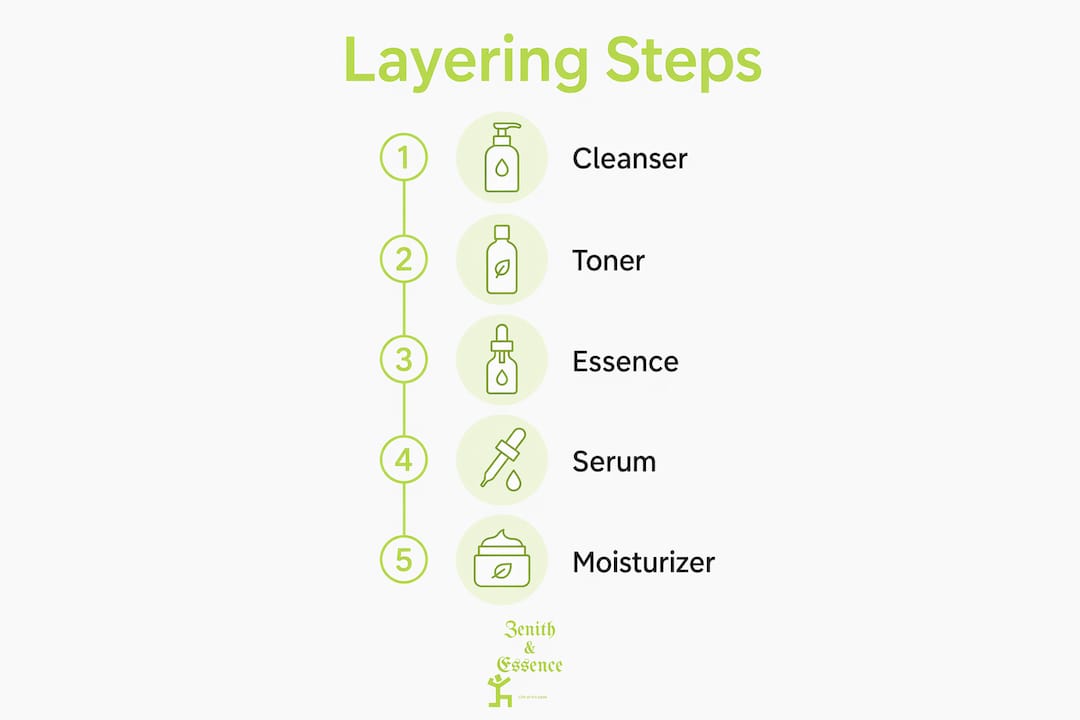
The standard layering sequence for a morning routine runs: cleanser, toner, essence, water-based serum, eye cream, moisturizer, and sunscreen. For an evening routine, you swap sunscreen for a face oil or sleeping mask as the final occlusive step. Each product category sits in this order because of its molecular weight, not convention.
Step | Product Type | Consistency | Purpose |
1 | Cleanser | Liquid/gel | Remove debris and prep skin |
2 | Toner/essence | Watery | Balance pH and prime absorption |
3 | Serum/ampoule | Thin liquid | Deliver concentrated actives |
4 | Eye cream | Light cream | Target delicate eye area |
5 | Moisturizer | Medium cream | Hydrate and support barrier |
6 | Face oil (PM) or sunscreen (AM) | Oil/thick lotion | Seal or protect |
Pro Tip: Cleansing and toning are not optional prep steps. They remove surface debris and reset your skin’s pH to between 4.5 and 5.5, which is the range where actives absorb most efficiently. Skipping them is like painting over a dirty wall.
Understanding quality ingredient selection also shapes how well your layering sequence performs. A well-formulated serum in the right position delivers far more than a poorly formulated one applied at any step.
What happens if you layer skincare products incorrectly?
Incorrect layering order is a leading cause of suboptimal skin results. It can nullify product efficacy while causing pilling, sensitivity, and pH imbalance. These are not minor inconveniences. They represent wasted money and, in some cases, real skin damage.
The most common mistake is applying a heavy cream before a lighter treatment. An occlusive forms a hydrophobic barrier that blocks serum penetration regardless of how high-quality the serum is. The active ingredients never reach the skin layers where they are meant to work.
Signs that your layering technique needs adjustment include:
Pilling: Products roll off your skin in small balls instead of absorbing. This happens when incompatible formulations are layered too quickly or in the wrong order.
Persistent redness or sensitivity: Applying actives on an unprepped, high-pH skin surface increases irritation risk significantly.
No visible results after 4–6 weeks: If your skin is not responding to a product you have used consistently, incorrect layering is a likely culprit before the product itself is at fault.
Greasy or tacky finish: Oils applied before water-based products prevent absorption and leave a residue that does not clear.
Breakouts from non-comedogenic products: Heavy occlusives applied before lighter treatments can trap debris and contribute to congestion.
The skin’s acid mantle operates at a pH between 4.5 and 5.5. Disrupting this range through incorrect product sequencing compromises barrier integrity and makes skin more reactive to everything that follows. A disrupted barrier is also more vulnerable to environmental stressors throughout the day.
Pro Tip: If you notice pilling or persistent sensitivity, strip your routine back to three steps: cleanser, one serum, and moisturizer. Reintroduce products one at a time in the correct order to identify where the breakdown is happening.
How long should you wait between applying skincare layers?
Timing between layers is not a minor detail. Waiting 15 seconds to 2 minutes between product applications ensures proper absorption and minimizes pilling and product mixing. Skipping this wait time is one of the most common reasons people report that their skincare routine feels ineffective.
Longer wait times matter because absorption is a physical process. Waiting 1–2 minutes between layers dramatically increases absorption efficiency and reduces product interaction issues. Rushing through a five-step routine in under two minutes means most of your products are mixing on the surface rather than penetrating individually.
Practical timing guidance by product type:
Toner and essence: 15–30 seconds. These watery formulas absorb almost immediately on clean skin.
Vitamin C serum: 60–90 seconds minimum. Vitamin C is pH-dependent and needs time to fully absorb before the next layer alters the surface environment.
Retinol or retinoids (PM): 20–30 minutes on dry skin. Applying retinoids on damp skin increases penetration and irritation risk simultaneously.
Moisturizer: 60 seconds before applying a face oil or sunscreen on top.
Sunscreen (AM): Apply last and allow 2 minutes before makeup. Sunscreen applied before moisturizer reduces UV coverage because the moisturizer dilutes the UV filter film.
The payoff for patience is real. Serums that absorb fully before moisturizer is applied deliver measurably better ingredient penetration and visible skin benefits over time. Building a two-minute buffer between your most active steps is the single easiest upgrade to any routine.
Which products should not be layered together?
Ingredient incompatibility is the most underestimated risk in skincare layering. Certain combinations actively work against each other, and layering them in the same session can cause irritation, reduced efficacy, or barrier damage.
Only one active ingredient per routine is the standard recommendation to prevent irritation and maximize efficacy. Combining multiple actives disrupts pH and causes sensitivity and redness. This guideline applies especially to exfoliating acids, retinoids, and vitamin C, which each require specific pH environments to function correctly.
Common incompatible pairings to avoid in the same session:
Vitamin C and benzoyl peroxide: Benzoyl peroxide oxidizes vitamin C, rendering it inactive before it reaches the skin.
Retinol and AHAs or BHAs: Both are exfoliating actives. Combining them in one session over-exfoliates the skin and compromises the barrier.
Niacinamide and vitamin C (high concentration): At high concentrations, these two can interact and cause flushing in sensitive skin types. Low-concentration niacinamide formulas are generally safe alongside vitamin C.
Multiple exfoliating acids in one session: Layering a glycolic acid toner with a salicylic acid serum doubles the exfoliation load and increases sensitivity risk significantly.
Retinoids and physical scrubs: Retinoids already accelerate cell turnover. Adding mechanical exfoliation on the same night creates excessive skin thinning.
Safe layering practices follow a clear logic:
Introduce one new active at a time, using it three times per week before daily use.
Alternate actives across your AM and PM routines rather than stacking them in one session.
Keep your routine to 3–5 layers. Exceeding 5–7 layers risks cumulative irritation as the skin barrier becomes overloaded.
Use a plain moisturizer as a buffer between a strong active and the next product if sensitivity is a concern.
Match your routine complexity to your skin’s current tolerance, not to an aspirational product count.
Different skin types also need different approaches. Oily skin tolerates more actives than dry or sensitized skin. If you have a compromised barrier, the priority is repair first: ceramide moisturizer, gentle cleanser, and SPF. Actives come later, once the barrier is stable. Learning to read ingredient labels is the fastest way to spot incompatible combinations before they cause problems.
Key Takeaways
Correct skincare layering order, from thinnest to thickest formulation, is the single most effective way to maximize ingredient absorption and protect your skin barrier.
Point | Details |
Thin-to-thick is the rule | Apply water-based products before creams and oils to prevent absorption blockage. |
Timing between layers matters | Wait 15 seconds to 2 minutes between steps to allow full absorption and prevent pilling. |
One active per session | Combining multiple actives in one routine disrupts pH and increases irritation risk. |
Sunscreen is always last (AM) | Applying sunscreen before moisturizer reduces UV coverage and defeats its purpose. |
Limit layers to 3–5 products | Exceeding 5–7 layers overloads the skin barrier and reduces overall routine efficacy. |
What I have learned from watching people layer skincare wrong
Most skincare mistakes are not about the wrong products. They are about the right products applied in the wrong order. I have seen people spend significant money on vitamin C serums and retinoids and then wonder why their skin looks the same after three months. Nine times out of ten, the sequence was off.
The insight that changed how I think about routines is this: intelligent layering over weeks improves skin texture and tone better than any single product alone. That means a well-ordered five-minute routine beats a chaotic ten-step one every time. Consistency in the correct sequence is what produces visible results.
The other mistake I see constantly is treating the routine as a collection of products rather than a system. Product consistency and absorption physics matter more than ingredient benefits alone. Thickness guides sequence. If you cannot tell which product is thinner, apply the one with the shorter ingredient list first.
My honest advice: build your routine around three non-negotiable steps first. Cleanser, one targeted serum, and a moisturizer with SPF in the morning. Get those three steps right, in the right order, with the right timing. Add layers only when your skin is stable and you have a clear reason for each addition. Patience with a simple, correctly ordered routine will outperform an ambitious one applied carelessly.
— Norman
Essencezenith’s collection for a well-ordered skincare routine
Building a routine that actually works starts with products formulated to layer well together. Essencezenith curates a sustainable skincare collection built around powerful, clean ingredients designed to absorb in the correct sequence without pilling or barrier disruption.

Every product in the Essencezenith range is selected with formulation consistency in mind, so you can build your thin-to-thick routine with confidence. The 30-day satisfaction guarantee means you can test your layering sequence without risk. If a product does not perform as expected within your routine, you can return any unused items. Fast shipping and transparent ingredient lists make it straightforward to build a routine that is both effective and sustainable.
FAQ
What is the correct order to apply skincare products?
Apply products from thinnest to thickest: cleanser, toner, serum, eye cream, moisturizer, and sunscreen in the morning. This sequence follows molecular weight principles and maximizes ingredient absorption.
Why does layering skincare in the wrong order cause pilling?
Pilling happens when incompatible formulations are layered too quickly or in the wrong sequence. Heavier products applied before lighter ones prevent absorption and cause the formulas to ball up on the skin’s surface.
How many skincare layers is too many?
An optimal routine uses 3–5 layers. Exceeding 5–7 products in one session risks cumulative irritation and diminishing returns as the skin barrier becomes overloaded.
Can you layer vitamin C and retinol in the same routine?
Vitamin C and retinol should not be used in the same session. Apply vitamin C in the morning and retinol at night to avoid pH conflicts and over-sensitizing the skin.
Does sunscreen go before or after moisturizer?
Sunscreen always goes last in the morning routine. Applying it before moisturizer or serums dilutes the UV filter film and reduces its protective coverage.
Recommended
Comments